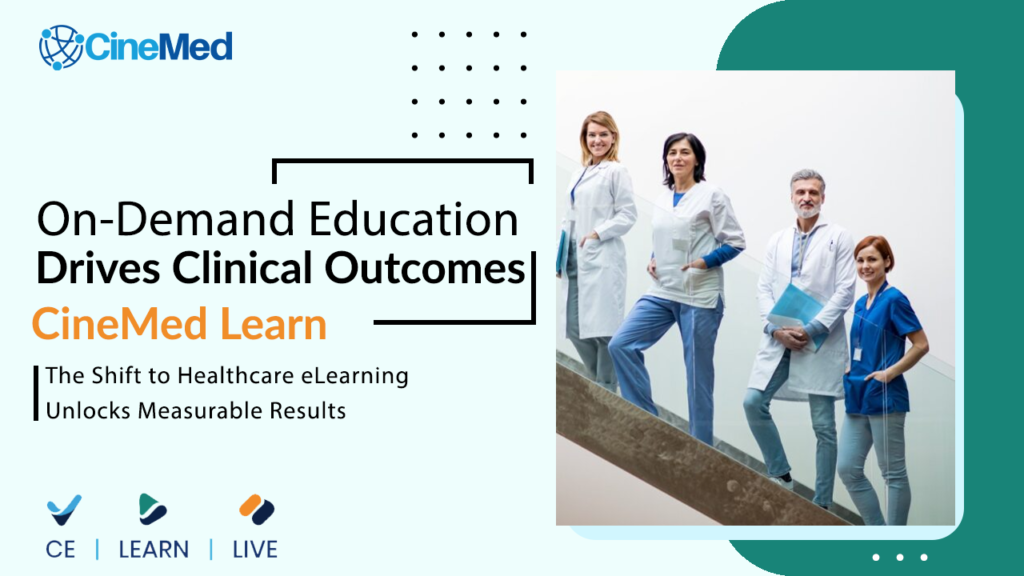
CineMed Learn: On-Demand Education That Drives Clinical Outcomes
What Is Driving the Shift to On-Demand Healthcare eLearning?
Healthcare professionals are choosing on-demand education because it respects their time while delivering superior learning outcomes. CineMed’s research consistently demonstrates that eLearning reduces training time by 40-60% compared to traditional classroom instruction—without sacrificing knowledge acquisition or clinical competency development.
The transformation in healthcare education isn’t subtle—it’s a fundamental restructuring of how medical professionals prefer to learn. According to Grand View Research’s 2024 Healthcare E-Learning Services Market Report, self-paced learning now accounts for 32.74% of all healthcare eLearning delivery modes, with clinical training modules representing 61.68% of content. Healthcare professionals aren’t just tolerating digital education—they’re actively demanding it.
The preference gap between educators and learners has reached a critical point. A study published in BMC Medical Education examining micro-learning’s effect on nursing students found that more than 90% of nursing students prefer new methods of evaluation and training over traditional approaches, even though approximately 70% of clinical educators continue using conventional teaching methods. This disconnect represents both an urgent challenge and a significant opportunity for healthcare organizations committed to workforce development and talent retention.
The evidence supporting digital learning effectiveness is now overwhelming and spans multiple dimensions of educational impact:
- Retention advantage: Research from the Research Institute of America demonstrates that eLearning increases retention rates to 25-60%, compared to just 8-10% for traditional face-to-face training—a difference that translates directly into improved clinical competency
- Time efficiency: Healthcare professionals master equivalent material in 40-60% less time than traditional classroom settings, freeing clinical hours for patient care
- Completion rates: Studies published in the Journal of European CME demonstrate that micro-learning achieves significantly higher engagement, with evaluation completion rates of 34.6% compared to 17.6% for traditional eLearning formats
- Knowledge application: A comprehensive meta-analysis by Cook et al. examining internet-based learning in health professions demonstrated pooled effect sizes of 1.00 for knowledge outcomes, confirming that digital delivery matches or exceeds traditional instruction
CineMed Learn was built on these research foundations—delivering flexible, evidence-based education that meets healthcare professionals where they are. As we explored in Building Tomorrow’s Healthcare Education: The CineMed Vision, the future of medical education demands integration, flexibility, and measurable outcomes rather than outdated delivery models that ignore how adults actually learn.
The global healthcare eLearning market reflects this transformation. Grand View Research projects growth at a 14.58% compound annual growth rate through 2030, driven by increasing demand for clinical training modules, rising preference for self-paced learning, and growing adoption of learning management system platforms for centralized training and compliance management. Organizations investing in flexible education infrastructure now will establish significant competitive advantages in talent recruitment, retention, and clinical excellence.
How Has Healthcare eLearning Evolved Beyond Static Modules?
Modern healthcare eLearning has transformed from passive slide presentations into interactive, outcomes-focused experiences that mirror real clinical decision-making. The shift reflects both advancing technology and deeper understanding of adult learning science—recognizing that engagement drives retention, and retention drives practice change.
A decade ago, digital CME meant clicking through PowerPoint slides converted to web format. Completion was the primary metric—and often the only metric. Whether learners actually retained information, let alone applied it in clinical practice, remained largely unmeasured and frequently unmeasurable. The education industry celebrated completion rates while ignoring the uncomfortable truth that most learners forgot the majority of content within weeks.
Today’s landscape looks fundamentally different. A 2024 systematic review published in BMC Medical Education analyzed 27 studies involving 3,895 participants and found that digital clinical skills teaching demonstrated improved or comparable outcomes to in-person instruction, with meta-analysis showing a mean difference increase of 1.93 in assessment outcomes. The research confirms what forward-thinking educators have long suspected: when designed correctly, digital learning doesn’t just match traditional methods—it exceeds them.
Mobile-first design has become essential rather than optional. Healthcare professionals access training between patient rounds, during commutes, on night shifts, and in brief windows between clinical responsibilities. Content that doesn’t render properly on smartphones or requires desktop access simply doesn’t get completed. The healthcare education market analysis indicates that 48% of new healthcare courses now integrate AI-driven personalization, while 39% adopt mobile learning modules—reflecting the industry’s recognition that accessibility determines engagement.
A systematic review published in Human Resources for Health synthesizing evidence from 44 studies confirmed that asynchronous, synchronous, blended, and self-learning methodologies all demonstrate effectiveness for continuous professional development when properly designed. The review noted that asynchronous eLearning has demonstrated particularly positive outcomes in enhancing healthcare knowledge and practices across diverse areas including smoking cessation counseling, breastfeeding awareness, and core clinical skills.
The outcomes imperative has fundamentally shifted focus from completion metrics to practice change. Modern healthcare education measurement encompasses multiple levels:
- Knowledge assessment: Testing whether learners understood the material through validated assessment instruments
- Competence demonstration: Evaluating whether learners can correctly apply knowledge in simulated clinical scenarios
- Performance measurement: Tracking whether learning actually translates to changed clinical practice behaviors
- Patient outcomes: The ultimate measure—does education improve care delivery and health outcomes for patients?
Research published in Cureus examining innovative approaches to continuing medical education found that 75% of healthcare professionals reported enhanced knowledge retention specifically related to microlearning approaches, with the concise, targeted nature of microlearning modules viewed as essential for reinforcing learning and improving information recall during actual clinical practice.
CineMed Learn embraces this evolution—moving beyond simple completion tracking to genuine outcomes measurement that demonstrates educational ROI to organizational leadership. This outcomes-focused approach aligns with the comprehensive framework we outlined for accreditation confidence, where measurement and documentation serve both compliance requirements and strategic organizational objectives.
What Does the CineMed Learn Content Portfolio Include?
CineMed Learn delivers a comprehensive portfolio spanning SCORM courses, micro-modules, video CME, and enterprise content licensing—all designed to integrate seamlessly into existing learning ecosystems while maintaining accreditation compliance and driving measurable clinical outcomes.
SCORM Courses and Micro-Modules
Full-length comprehensive courses address complex clinical topics requiring sustained engagement and deep learning. These SCORM-compliant modules integrate with any learning management system, preserving your existing technology investments while adding accredited content libraries. Organizations don’t need to replace infrastructure they’ve already invested in—CineMed content works within existing systems through standard SCORM and xAPI compatibility.
Micro-learning modules—typically 5-15 minutes in duration—address specific competencies without overwhelming busy clinical schedules. The evidence supporting this approach continues strengthening. Research published in the Journal of European CME examining microlearning program effectiveness found that participants in microlearning programs showed evaluation completion rates of 34.6% compared to just 17.6% in traditional eLearning programs—demonstrating that shorter, focused content drives meaningfully higher engagement.
The Cureus study on innovative CME approaches reinforces these findings, reporting that microlearning was regularly utilized by 78% of healthcare professionals surveyed, with 68% indicating it as their preferred learning method specifically due to its flexibility and efficiency. Satisfaction rates reached 82%, with healthcare professionals citing the ability to integrate learning into daily routines without interrupting patient care as particularly valuable.
Adaptive learning pathways allow content to adjust based on learner performance, focusing attention where knowledge gaps exist rather than forcing everyone through identical sequences regardless of prior expertise. This personalization respects both learner time and organizational resources while ensuring that education addresses actual competency needs.
Video CME and Micro-Certifications
Expert faculty presentations bring thought leaders directly to learners regardless of geographic location. Procedure demonstrations provide visual learning that text descriptions simply cannot replicate—particularly critical for clinical skills requiring precise technique. Case-based scenarios present realistic clinical challenges requiring diagnostic reasoning and treatment planning decisions, building the analytical capabilities essential for quality patient care.
A study published in Frontiers in Medicine examining case-based eLearning demonstrated that these approaches effectively promote clinical reasoning and enhance learning outcomes, particularly when integrated with feedback systems. The research found high acceptance and satisfaction with case-based learning methods, with evidence suggesting they serve as effective bridges between theoretical knowledge and translational clinical application.
Specialty micro-credentials offer focused certifications in emerging clinical areas—allowing healthcare professionals to demonstrate competency in specific domains without committing to lengthy certification programs. These targeted credentials serve both individual professional development goals and organizational competency documentation requirements.
Enterprise Content Licensing and Custom Portals
White-label solutions allow organizations to deliver CineMed educational excellence under their own branding. This approach maintains organizational identity and brand consistency while providing access to professionally developed, accreditation-ready content. Healthcare systems, medical societies, and industry partners leverage these solutions to enhance their educational offerings without building content development capabilities from scratch.
Custom learning portals create cohesive experiences reflecting organizational identity while providing access to extensive accredited content libraries. These branded environments integrate with existing technology infrastructure through standard LMS protocols, creating seamless user experiences that encourage sustained engagement and completion.
Case Study Insight: MedStar Health implemented a microlearning approach for patient education that achieved remarkable results—nearly 90% of over 300 patients scheduled for heart catheterizations completed the education modules. Patients reported reduced anxiety, increased confidence, and appeared more engaged throughout their care process. The same engagement principles driving patient education success apply directly to healthcare professional development programs.
Why Does Instructional Design Excellence Matter for Clinical eLearning?
Effective healthcare eLearning requires more than subject matter expertise—it demands instructional design grounded in learning science that translates clinical knowledge into retained competencies and changed practice behaviors. Without proper instructional design, even excellent clinical content fails to produce meaningful learning outcomes.
Accelerated Production Without Compromising Quality
CineMed’s streamlined development processes enable rapid content creation responding to emerging clinical needs. When new treatment protocols emerge, regulatory requirements change, or clinical guidelines update, organizations need updated training quickly—not months of development delays. Our production workflows balance speed with quality, ensuring content reaches learners while remaining clinically current.
Subject matter expert collaboration frameworks ensure clinical accuracy while instructional designers optimize content for learning effectiveness. This partnership model produces education that’s both medically rigorous and pedagogically sound—neither sacrificing clinical precision for engagement nor burying critical content in inaccessible formats.
Quality assurance protocols maintain consistency across content libraries, ensuring every module meets accreditation standards and organizational expectations. This systematic approach to quality enables scalable content production without the quality degradation that often accompanies rapid expansion.
Learning Science in Action
Evidence-based instructional strategies inform every design decision at CineMed Learn. Research published in Frontiers in Medicine demonstrates that case-based eLearning approaches effectively promote clinical reasoning and enhance learning outcomes—particularly when integrated with immediate feedback systems that correct misconceptions before they become ingrained.
A systematic review examining knowledge retention following online medical education identified four key factors correlating with improved online learning outcomes: interactivity, practice exercises, repetition, and feedback. The research noted that physicians retained only 40% of initial knowledge gains 4-6 months after completing online tutorials without reinforcement—highlighting the critical importance of spaced repetition and ongoing engagement.
CineMed Learn incorporates all four evidence-based factors into every content development project:
- Interactivity: Active participation transforms passive consumption into engaged learning, with knowledge checks, decision points, and branching scenarios maintaining attention and promoting deeper processing
- Practice exercises: Application cements understanding, moving knowledge from short-term recall to long-term competency through realistic clinical scenarios
- Repetition: Spaced review defeats the forgetting curve, with strategically timed reinforcement maintaining knowledge accessibility when clinical situations demand it
- Feedback: Immediate correction prevents error reinforcement, ensuring learners develop correct mental models rather than practicing mistakes
The global model for effective use of e-learning in health published in Telemedicine and e-Health confirms that e-learning programs are significantly more effective than no training intervention and comparable to traditional teaching methods, with meta-analysis showing pooled effect sizes of 1.00 for knowledge outcomes, 0.85 for skills, and 0.82 for learner behaviors and patient effects. These findings validate that properly designed eLearning delivers outcomes matching or exceeding traditional instruction—at significantly lower cost and greater accessibility.
How Does Flexible Hosting Deliver Measurable Results?
CineMed Learn meets organizations where they are technologically—whether hosting content on our platform, integrating with existing LMS infrastructure, or distributing across multiple channels—while providing analytics that demonstrate educational impact and support continuous improvement.
Host Where It Makes Sense
CineMed LMS hosting provides turnkey solutions for organizations preferring managed platforms. Full administrative capabilities, learner tracking, credit reporting, and comprehensive analytics come standard—eliminating the need for internal LMS expertise while ensuring professional-grade learning management.
Client LMS integration preserves existing technology investments. SCORM and xAPI compatibility ensure CineMed content functions properly within virtually any modern learning management system. Organizations don’t need to abandon systems their staff already know how to use—we integrate with existing infrastructure rather than requiring disruptive technology changes.
Multi-platform distribution extends educational reach beyond traditional LMS environments. Content accessible via web browsers, mobile apps, and embedded portal integrations meets learners wherever they prefer to access education. This flexibility acknowledges the reality that healthcare professionals learn in diverse contexts—at workstations between patients, on tablets during breaks, on smartphones during commutes.
Analytics That Drive Improvement
Learner progress tracking provides visibility into individual and cohort advancement through educational pathways. Rather than simple completion checkboxes, CineMed analytics reveal engagement patterns, time investment, assessment performance, and learning trajectory—enabling both individual support and program optimization.
Knowledge assessment results identify concepts requiring additional reinforcement or content revision. When assessment data reveals persistent knowledge gaps across learner cohorts, instructional designers can revise content to address specific learning challenges rather than hoping increased exposure somehow produces better outcomes.
Engagement metrics reveal how learners interact with content—time on page, video completion rates, interaction patterns, revisit frequency—providing insights beyond simple completion tracking. These behavioral signals enable continuous improvement based on actual learner experience rather than assumptions about what should work.
The systematic review of eLearning effectiveness for healthcare professionals emphasized that successful eLearning implementation requires attention to factors including knowledge acquisition, skill enhancement, adaptability to diverse learning styles, and contribution to improved patient care and health outcomes. CineMed analytics address each of these dimensions, providing the data infrastructure necessary for demonstrating educational value and guiding strategic program development.
How Do You Start Building Outcomes-Driven Healthcare eLearning Today?
The path to effective healthcare eLearning begins with understanding organizational needs, selecting appropriate delivery methods, and establishing measurement frameworks that demonstrate educational value to stakeholders while driving genuine clinical improvement.
The evidence supporting on-demand healthcare education is clear and continues strengthening. The 2024 Cureus study on innovative approaches to continuing medical education found that 82% of healthcare professionals expressed high satisfaction with microlearning, with 78% utilizing it regularly and 68% preferring it specifically for flexibility. The study noted that 88% of participants identified flexibility and accessibility as key advantages of innovative CME methods, enabling seamless integration of learning into daily routines and accommodating busy clinical schedules.
Organizations implementing comprehensive eLearning strategies report transformative results. IBM famously saved $200 million after transitioning to eLearning while enabling participants to learn nearly five times more material without increasing time spent in training. Healthcare organizations pursuing similar transformations gain competitive advantages in workforce development, talent retention, regulatory compliance, and ultimately clinical excellence.
The shift to on-demand CME represents more than technological modernization—it reflects fundamental recognition that healthcare professionals deserve education designed for how they actually live and work. Traditional models requiring extended time away from clinical responsibilities increasingly conflict with staffing pressures, patient care demands, and professional expectations for flexible development opportunities.
CineMed Learn provides the content portfolio, instructional design expertise, and flexible delivery options healthcare organizations need to meet this moment. From SCORM courses integrating with existing infrastructure to custom portal development reflecting organizational branding, solutions scale to match organizational complexity and strategic ambition.
The question isn’t whether healthcare professionals will embrace on-demand education—they already have, overwhelmingly. The question is whether your organization will provide the flexible, outcomes-driven learning experiences your workforce expects, deserves, and increasingly demands.
Ready to explore how CineMed Learn can transform your healthcare education programs?
Frequently Asked Questions
What types of healthcare professionals can earn credits through CineMed Learn content?
CineMed maintains joint accreditation from ACCME, ANCC, and AAPA, enabling credit awards for physicians, nurses, physician assistants, and pharmacists through a single content library. This multi-accreditation capability supports interprofessional education initiatives increasingly essential for team-based care delivery models.
How does micro-learning compare to traditional CME for knowledge retention?
Research consistently demonstrates superior retention with micro-learning approaches. Studies show eLearning increases retention rates to 25-60% compared to just 8-10% for traditional face-to-face instruction. Micro-learning’s focused format drives even higher engagement and completion rates—research in the Journal of European CME found evaluation completion rates of 34.6% for microlearning versus 17.6% for traditional formats.
Can CineMed Learn content integrate with our existing learning management system?
Yes. All CineMed Learn content is SCORM and xAPI compliant, ensuring compatibility with virtually any modern LMS. Organizations preserve existing technology investments while gaining access to accredited content libraries and professional instructional design expertise.
How quickly can custom content be developed for organization-specific needs?
CineMed’s accelerated production processes enable rapid content development responding to emerging clinical needs. Timeline varies based on complexity and scope, but streamlined SME collaboration frameworks and established quality assurance protocols minimize development cycles without compromising educational rigor or accreditation compliance.
What analytics and reporting capabilities are available?
CineMed Learn provides comprehensive analytics including learner progress tracking, knowledge assessment results, engagement metrics, and continuous improvement insights. These capabilities support both operational management and ROI demonstration to organizational leadership—essential for justifying educational investments and guiding strategic program development.
Works Cited
Bannister, J., Neve, M., & Kolanko, C. (2020). Increased educational reach through a microlearning approach: Can higher participation translate to improved outcomes? Journal of European CME, 9(1), 1834761
Ben Aryee, G. F., et al. (2024). Effectiveness of eLearning programme for capacity building of healthcare professionals: A systematic review Human Resources for Health, 22, 60
Ertl, S., Wadowski, P. P., & Löffler-Stastka, H. (2024). Improving students’ performance via case-based e-learning Frontiers in Medicine, 11, 1401124
Grand View Research. (2024). Healthcare e-learning services market size report, 2030
Mannan, M., et al. (2024). Innovative approaches to continuing medical education Cureus, 16(11), e74638
McGee, R. G., & Malau-Aduli, B. S. (2024). Digital learning of clinical skills and its impact on medical students’ academic performance: A systematic review BMC Medical Education, 24, 1471
Ruiz, J. G., et al. (2006). A global model for effective use and evaluation of e-learning in health Telemedicine and e-Health, 12(5), 479-491
Sabouni, A., et al. (2022). The effect of micro-learning on learning and self-efficacy of nursing students: An interventional study BMC Medical Education, 22, 664
Wardini, S., et al. (2021). Evaluating knowledge retention and perceived benefits of medical webinar for professional development BMC Medical Education, 21, 628